Pages

Tuesday, August 2, 2011

Materialism Blinds

About a month ago Rabbi Slifkin began a series of posts criticizing Rabbi Avi Shafran’s article Science, Blinded regarding bias in the academic world. Personally I was happy to see such an article appear in Cross-Currents but apparently this small piece offended Rabbi Slifkin. This post (and several future ones) analyzes Rabbi Slifkin’s comments regarding this article.

In his introductory paragraph, Rabbi Slifkin writes as follows:

That's why I put a warning at the beginning of "The Challenge of Creation," stating that the book is not appropriate for those with little exposure to science and who are opposed to the Maimonidean approach. Besides, while recent special creation is not a core belief of Orthodox Judaism…

Absolutely amazing. On the one hand Rabbi Slifkin strives to impart to his readers that his book is aligned with the “Maimonedian” approach. Yet in his very next breath he states that “recent special creation is not a core belief of Orthodox Judaism”. Anyone familiar with the works of Maimonides understands how absurd this is. It is hard to find a belief which the Rambam held as “core” more than recent special creation.

Rabbi Slifkin takes issue with Rabbi Shafran as follows:

First of all, and most obviously, the idea that religious figures who oppose evolution "can truly perceive the world with clarity," as a result of having "overcome the preconceptions, desires and imperfections of character to which we all play host," is ludicrous. Overcoming imperfections of character is a fine thing, but it does not assist one in evaluating evolution.

It most certainly does. Rabbi Shafran explains in the next few sentences that essentially evolution does not possess any empirical evidence. The implication is obvious. Those scientists who maintain an uncompromising conviction in evolution only do so as a consequence of their desire to believe in it, nothing more.

Rabbi Shafran’s message is simple. To the extent that an individual is able to refine his character, to let go of false preconceptions, to eliminate erroneous attitudes, and to cleanse himself of base desires, so too will he be able to see the truth about the nature of the material world. Why? Because he is no longer predisposed to explain the material in necessarily material terms. He is open to all options. On the other hand, evolutionary scientists are biased by their a priori adoption of a Materialist worldview and thus see nothing! They ignore the open lack of evidence and see only what they want to see. They are the last people who can be trusted to weigh the merits of evolution.

Rabbi Slifkin writes:

On the contrary; since those who oppose evolution inevitably subscribe to a religious worldview in which evolution is theologically problematic at best and usually entirely unacceptable, they are overwhelmingly, critically biased against any evidence supporting it.

This may have been true at one time but it is clearly not true today. There are plenty of religiously unaffiliated scientists who challenge evolution on its face. David Berlinski comes to mind…

In the same vein, it should be pointed out that amongst the ranks of those who do believe in evolution, you will find both atheists and devoutly religious

Vastly, overwhelmingly atheistic with a tiny smattering of devoutly religious. The latter are the odd men out, trying desperately to reconcile a patently atheistic theory with the uncompromising truth of Creation.

In the interest of brevity, we will bring this post to a close. More to come shortly bi’ezras Hashem.

Monday, August 1, 2011

Natan Slifkin’s 10 questions

B”H

NS published today a pilpul around the Torah understanding of the animal world and the profound motivations of his ideological opponents.

This is explicitly related to my approach to this issue, as he mentions my name many times.

Interestingly, he did not answer the questions I posted recently in our blogspot, even the most elemental one, i.e.

NS: wrote:

“…In fact, the hyrax appears to be more of a maaleh gerah than the hare.”

I asked:

In which page in NS’s book (first or second edition) did he write what is his definition of “maaleh gerah” and the sources on what he based his definition?

As far as you do not define a category, you cannot include or exclude any animal.

I am still waiting…

Now he wants to distract the readers with his 10 questions:

  1. Are the lama, alpaca, vicuna and guanaco to be classified as being of the same min (type) as the camel?
  2. Is the rabbit classified as being of the same min as the hare?
  3. Does cecotrophy (the reingestion of special fecal pellets) by hares and rabbits rate as ma’aleh gerah?
  4. Do we believe those zoologists who say that the capybara practices cecotrophy?
  5. Is the capybara considered to be a sheretz or a chayah?
  6. Is the shafan the hyrax?
  7. Does the hyrax practice merycism?
  8. Is merycism considered to be maaleh gerah?
  9. Is the alleged merycism of koalas and proboscis monkeys the same as that of the hyrax?
  10. Is it likely that the shafan and arneves are extinct, unknown animals?

I have to acknowledge that after reading these 10 questions I am very happy bechasde Hashem Yitbarach, because the first 9 questions are frontally approached in our B”H forthcoming book “The enigma of the biblical shafan” (with more than 500 Torah and science sources).

Question number 10 was not addressed in our book because I did not consider it relevant to our approach.

Special attention was invested B”H in defining all the relevant concepts and checking that the answers to the 9 individual questions are consistent with each other.

Meanwhile, I would like to ask in which page of his first or second edition, a scientific source was provided for the purported hyrax merycism.

Otherwise, please specify any definition of “maaleh gerah” that includes the hyrax.

Friday, July 29, 2011

Natan Slifkin surprised by the disfavored hyrax

B”H

Natan Slifkin (NS) after acknowledging his surprise by the publication of the new letters supporting the identification of the biblical shafan as the rabbit and not the hyrax, he presents a few points.

You can see more details on this on a previous post: Hyrax out of favor

Let’s try B”H to analyze briefly some of his points.

An extensive elaboration appears in the book “The enigma of the Biblical shafan”.

1. NS acknowledges that many Spanish Rishonim identify the Biblical shafan as the rabbit.

2. NS claims that when Rav Saadiah Gaon translated shafan as the “wbr”, he intended the hyrax; but as written in the book, after our extensive research we can say that there is no conclusive evidence that this was Rab Saadia’s necessary opinion, because of the 4 points explained there.

3. NS wrote: “rabbits do not live anywhere near Eretz Yisrael…”

The relevance of his statement is questionable, but nevertheless it would be convenient if the facts are checked again.

4. NS wrote: “The only rabbits which hide under rocks are the African rock hares, which only live in Southern Africa, and are in any case so similar in appearance to the hares of Israel (the arneves) that it is hard to imagine that they would be rated as a separate min”.

Again, facts should be checked.

Regarding the “separate min” we explained it in the book with many Torah sources and many science sources why they are considered to different minim.

5. NS wrote: “…if one is going to consider the hyrax as a sheretz, then kal v’chomer that the rabbit, which is much smaller…”

In which page in NS’s book (first or second edition) did he write what is his definition of “sheretz” and the sources on what he based his definition?

6. NS: wrote: “…In fact, the hyrax appears to be more of a maaleh gerah than the hare.”

In which page in NS’s book (first or second edition) did he write what is his definition of “maaleh gerah” and the sources on what he based his definition?

As far as you do not define a category, you cannot include or exclude any animal.

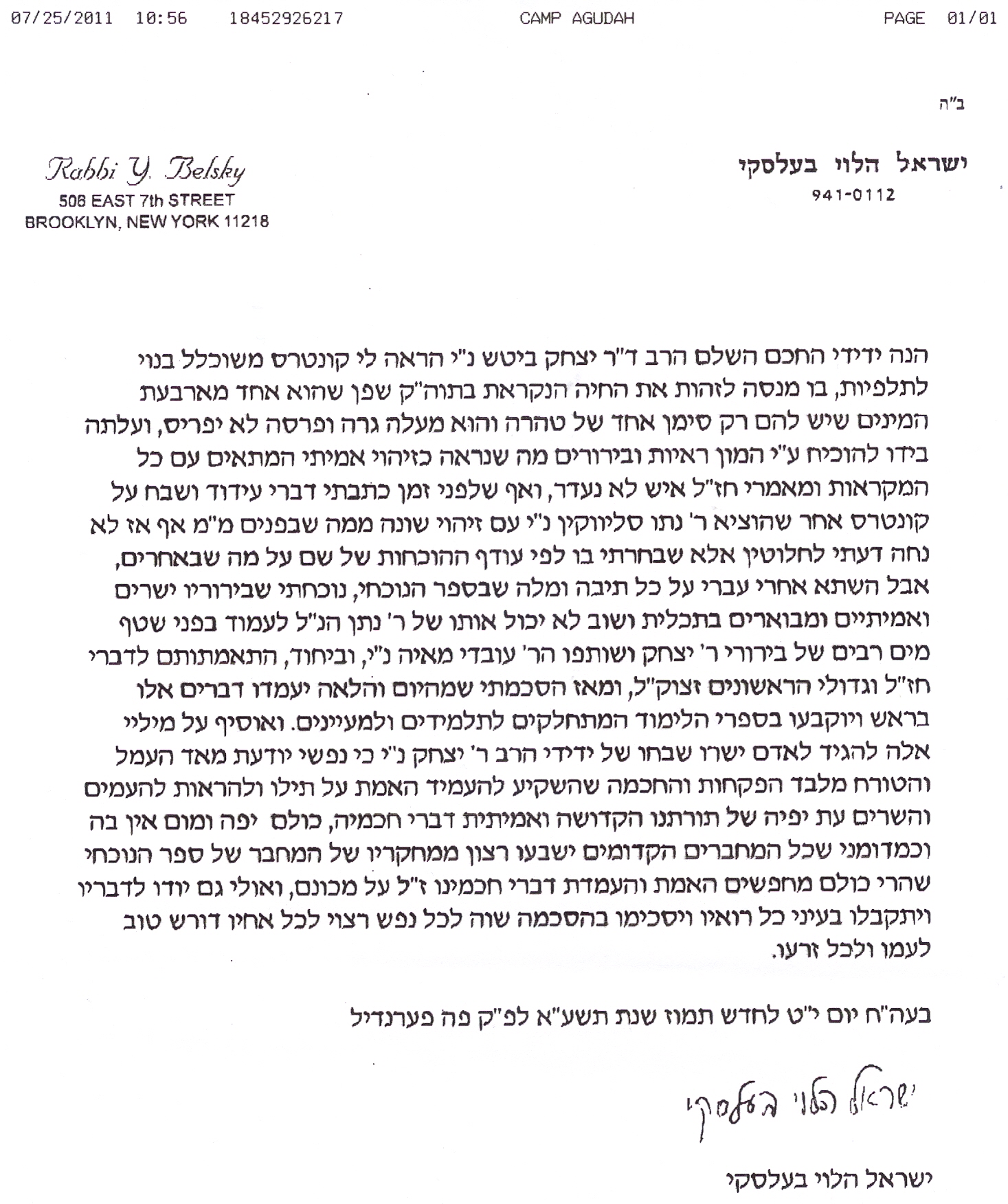
Meanwhile, if you have not read the original letters, you can find them in the following links.

www.tovnet.org/shafan/ShafanHaskamaRavYisroelBelsky19Tamuz5771.jpg www.tovnet.org/shafan/ShafanHaskamaRavYisraelMeirLevinger18Tamuz5771.pdf www.tovnet.org/shafan/ShafanHaskamaRavAmitaiBenDavid16Tamuz5771.pdf

Monday, July 25, 2011

The Nature of "The" Rakia, Part Eight--A Superior Understanding of Pesachim 94b?

As promised, I shall deal with the passage in Pesachim 94b that describes the sun as travelling behind the rakia at night.

Now, it is of course true that the unidentified “Chachmei Yisroel” of Gemora Pesachim 94b (taken literally) posit that at night, when we do not see the sun, the sun travels “behind the rakia.” And one would reasonably intuit that this indicates they thought the reason we do not see the sun at night is that the rakia (or rather, the back layer of the rakia) is opaque..

But the following question arises: Must we say that this passage shows that Chazal thought of the celestial-rakia as opaque, rendering it at odds with

(a) the Midrash we cited about Avraham Avinu viewing the stars from the back of the rakia, and

(b) the fact likely recognized by Chazal, and certainly by rishonim, that the sun lights the moon?

My answer: Not at all! I will propose, with support from the text, another explanation for how the Gemora Pesachim understands why, at night, when the sun is above the rakia, it cannot be seen.

We note the following:

(a) The Pesachim 94b passage about the path of the sun behind the rakia does not actually say that our inability to see the sun at night is due to any intrinsic opacity[1] or solidity of the celestial rakia

(b) Indeed, no talmudic passage, including this one, actually says that the celestial rakia is either solid or intrinsically opaque.

(c) The expression “עובי הרקיע,” usually translated “thickness of the rakia,” does not in itself inform on the rakia’s texture or transparency. Both the Rambam[2] and the Ralbag[3] also speak of the “עובי” or “עבי” of the spheres, yet they describe the spheres as being ethereal, weightless and colorless. The term “עובי הרקיע” simply refers to the depth—the distance—the rakia spans, whatever texture or substance it may have.[4]

(d) Thus the only feature the Gemora Pesachim 94b does ascribe to the rakia is vast depth.

(e) The preceding Gemara passage describes each of the thousands of the stars we see as specks in the sky to actually be many times the size of earth.

I humbly suggest on this basis that Pesachim 94b is working with the observable fact that distance diminishes the apparent size of objects, to the extent of their ultimate disappearance from sight. This is why those stars, each thousands of times the size of earth, appear to us as mere specks. Now, if the sun travels above the entire vast area of stars, even beyond those stars so far away they can barely be seen, this would account for, and indeed necessitate, that the sun at night must be so far away that it should be impossible to see it at all. We cannot see the sun at night, when it’s behind the rakia, because it is so distant, not because of any opaqueness. The transparent character of the entire celestial rakia, as described by the rishonim, remains intact.

This would fully explain how Chazal could have visualized Avraham seeing the stars from behind the most distant celestial sphere, whereas we cannot see the sun that is behind the dome at night. This would assume there are more stars we cannot see that are further from the earth, as the Gemara implies. (Absence of a filtering atmosphere in space would also contribute to better visibility, but this is not spoken of in the Talmud.)

And this would also explain how the sun’s rays, coming from one side of the rakia, could be seen as illuminating the otherwise dark moon, at an angle at which it would be lit in phases by the sun’s rays. (I am speculating that the moon at night does not join the sun behind the dome.[5]

I venture to call this a superior explanation of the passage in Pesachim, because this explanation uses only the very components and features that Gemora passage (together with its contextual surroundings) itself explicitly mentions, without introducing extraneous and speculative factors and components (such as solidity and opaqueness) that, as we have shown, contradict other talmudic and midrashic sources[6] (—although it still remains at odds with the shita that the sun at night travels beneath the earth).

And this would eliminate a machlokess between Chazal, with them all agreeing that the substance within which the stars are located does not have an opaque back.

All the above is following the basic understanding that the Gemora Pesachim 94b is indeed speaking about the daily path of the sun’s body. This is indeed how Rabbeynu Chananel, referencing a “Braissa D’Rabbeynu Shmuel,”[7] takes it.[8] I am also working on another altogether different possibility. ב”נ I will post it in the future if it turns out to be good enough for presentation.


[1] I say “intrinsically,” because the sky, one of the suggested definitions of rakia, turns opaque colors—blue, gray, orange and red due to the action of the sun’s rays upon it. This, despite the fact that the atmosphere itself is intrinsically transparent. When Chazal say the sky is the color of the sea, it is no more indicative of intrinsic opaqueness than it is indicative of opaqueness when we say the sky is blue.

[2] Rambam, Moreh Nevuchim 3:14 speaks of עבי הגלגל, and treats it synonymously with the word for “distance”:

וגם כן היותי שומע תמיד מכל מי שידע דבר מחכמת התבונה, שהוא חושב לגוזמא מה שזכרוהו החכמים ז"ל מן הרחקים, שהם אמרו שעובי כל גלגל מהלך ת"ק שנה , ובין כל גלגל וגלגל מהלך ת״ק שנה
--and indeed, in Moreh Nevuchim 1:57, he describes the spheres as consisting of non-earthly, indescribable material: “[N]otwithstanding all the efforts of the mind, we can obtain no knowledge of the essence of the heavens—a revolving substance which has been measured by us in spans and cubits, and examined even as regards the proportions of the several spheres to each other and respecting most of their motions—although we know that they must consist of matter and form; but since the matter is unlike sublunary matter, we can only describe the heavens in terms expressing negative properties, but not in terms denoting positive qualities. Thus we say that the heavens are not light, not heavy, not passive and therefore not subject to impressions, and that they do not possess the sensations of taste and smell: or we use similar negative attributes. All this we do, because we do not know their substance.”

Likewise, in Mishneh Torah Hilchos Yesodei HaTorah 3:3 he describes the galgalim as weightless, tasteless, and lacking any aroma, since such properties only exist in the sublunar world.

[3] Ralbag in his Breishis commentary refers to the rakia’s thickness as a fact in the name of Chazal yet simultaneously describes the rakia as weightless and transparent.

[4] Also relevant:

מדרש רבה דברים פרשה ב
... ד"ה ב לג: “ויתפלל אליו [מנשה] ויעתר לו ויחתר לו." מלמד שהיו מלאכי השרת מסתמין את חלונות של רקיע שלא תעלה תפלתו לשמים. מה עשה הקב"ה? חתר את הרקיע מתחת כסא הכבוד וקיבל את תפלתו וישיבהו ירושלים למלכותו..
Chazal here speak of the “windows” of the rakia, and the “piercing of the heavens,” in an obviously poetical, non-physical way.)

[5] This speculation must also be made in the approach that the reason the sun cannot be seen at night is that the rakia’s back layer is opaque—which does not solve the problem pointed out, that this would prevent the moon from being lit by the sun.

[7] The Sefer Hashavas Aveida identifies this braissa with Pirkei D’Rebbi Eliezer.

[8] Rabbeynu Chananel on Pesachim 94a

ופירש רבינו שמואל בברייתא שלו כי הרקיע עשוי ככובא, הגלגל קבוע והמזלוח חוזרין, ותניא כדבעינן למימר קמן, כי החמה מהלכת בלילה למעלה מן הרקיע מן המערב למזרח, וכשמגעת לחלון שזורחת ממנו, לאלתר עולה עמוד השחר, והחמה מהלכת בעוביו של רקיע, וכשתגיע לסוף עביו של רקיע לצד הנראה לבני אדם, מיד מנצח על הארץ ומהלכת ביום כולו ממזרח למערב. וכן בשקיעות, מהלכת בעביו של רקיע, וכשתצא מעובי הרקיע כולו--מיד הכוכבים נראין.

Hyrax out of favor

B”H

Recently Natan Slifkin announced the publication of the 2nd edition of his book on the hyrax = the biblical shafan.

In that new book, as well as in the previous one, I could not find any biological reason that justifies calling the hyrax “maaleh gerah”.

If the hyrax is a “non-ruminant, non-cecotroph, non-merycist species” how could the Torah call the hyrax “maaleh gera”?

So the obvious alternative is to say that the hyrax is not the biblical shafan.

Indeed, Natan Slifkin already made a partial concession in his blogspot on 18 Jul 11 when he wrote:

“The hyrax is not as perfect a candidate for the shafan as many would like…”

An interesting coincidence, the timing of Natan Slifkin’s publication of his new book with the moment I received B”H 3 significant letters:

1. An approbation letter to the new book "The enigma of the Biblical shafan" from HaRav Amitai Ben David shlit"a, author of the famous book "Sichat Chulin" on Masechet Chulin, where he acknowledges that the biblical shafan is not the hyrax.

2. An approbation letter from HaRav Yisrael Meir Levinger Shlit"a, author of the famous book "Maor LeMasechet Chulin", where he acknowledges that the biblical shafan is not the hyrax.

3. An approbation letter from HaRav HaGaon Rav Yisroel Belsky Shlit"a, Rosh Yeshivat Torah Vadaat and one of the chief experts for the Orthodox Union, where he acknowledges that the biblical shafan is not the hyrax.

Please remember that Natan Slifkin stated in his first edition, page102 that

“…the shafan is the hyrax. This is also the preferred conclusion of the contemporary Torah scholars who have published works specializing in animals of the Torah, Rabbi Yisrael Meir Levinger and Rabbi Amitai Ben-David…”.

The same statement appears in the second edition pages 90-91.

But now, after these two “contemporary Torah scholars who have published works specializing in animals of the Torah” have read and studied the arguments why the hyrax cannot be the biblical shafan, they acknowledged.

As HaRav HaGaon Rav Belsky שליט"א wrote in his approbation letter, I also hope B”H that many more will reevaluate this issue and arrive at the same conclusion.

P. S. You can find a copy of the above mentioned letters in the following links.

www.tovnet.org/shafan/ShafanHaskamaRavYisroelBelsky19Tamuz5771.jpg www.tovnet.org/shafan/ShafanHaskamaRavYisraelMeirLevinger18Tamuz5771.pdf www.tovnet.org/shafan/ShafanHaskamaRavAmitaiBenDavid16Tamuz5771.pdf

Friday, July 15, 2011

The Nature of “The” Rakia, Part Seven--Chazal Did Not [at] All Think the Celestial Rakia is Opaque

clip_image002

Rabbi Slifkin’s final mistake pertains to what he claims Chazal held about the opacity, or lack thereof, of the celestial-rakia. He points to the Gemora in Pesachim 94a as proof that Chazal universally held that the celestial rakia has an opaque surface (in addition to being a solid dome), such that would block the sight of anything behind it, specifically the sun in its imagined travels.[1] That this is erroneous—i.e., that not all Chazal held this, and perhaps none held this—can be plainly seen from a Midrash about Avraham Avinu with which Rashi has made us all familiar:

מדרש רבה בראשית פרשה מד

אמר רבי יהודה בשם ר' יוחנן העלה אותו למעלה מכיפת הרקיע הוא דאמר ליה הבט נא השמימה אין הבטה אלא מלמעלה למטה

Said Rebbi Yehudah in the name of Rebbi Yochonon:[2] [When Hashem wanted to impress Avraham with how numerous his descendents will be, he had him look at the stars—but not up at the stars.] He raised him above the כיפת הרקיע, the rakia’s sphere [or “dome,” and Avraham gazed down from there and saw the stars]. This is why it says “הבט נא השמימה”, “Gaze [down] at the heavens—for the term “הבט” connotes gazing from a higher vantage point towards something at a lower level.

Chazal (or at least those individuals among Chazal who promulgated this teaching) did not visualize the part of the rakia behind the stars as opaque, such that it would block our sight of anything on the other side of it (such as the stars, or the sight of the sun in its imagined course). In describing Avraham’s prophetic vision,[3] when Hashem wanted him to see the uncountable number of stars, Chazal visualized Avraham as being positioned above the dome of the rakia—the same place that the Gemora Pesachim places the sun at night—and looking downwards to see the stars. Now, to look down from the back of the rakia and see the stars—and certainly to see more stars than what are visible from earth—requires visualizing the rakia as being transparent, not opaque. Indeed, if the back of the rakia were opaque, it would be the worst place from which to see the stars!

(Furthermore, we note that Avraham is not depicted—neither literally nor even poetically—as shattering anything on his way up through the rakia, and nor is Hashem depicted as “opening the heavenly spheres” for him to pass through them. This again indicates that Chazal visualized the rakia as a non-solid substance—meaning no more solid than, say, the atmosphere; and probably, as the rishonim took it, as even less solid.)

clip_image004Secondly, Chazal understood that the moon’s light is only due to the sun’s.[4] If at night the sun is behind an opaque surface that prevents us from seeing it, how can one account for the moon’s lit surface? And of course, there is the admission made by Rabbi Shimon bar Yochai that we simply do not know if the movement of the stars are indeed related to any celestial spheres. [5]

These questions would all be answered by accepting that at least some of Chazal, if not all of Chazal, did not think of the rakia as intrinsically opaque or solid. And indeed, we have seen that there are statements from Chazal indicating that at least some of them, if not all of them, thought of the rakia as non-solid and transparent. These facts certainly belie Rabbi Slifkin’s claim that Chazal had a universal mesorah that the earth is covered by a solid, opaque dome.

In the next posts, I will suggest that even according to the Gemora Pesachim that deals with the sun’s path at night, we need not say the reason the sun is unseen at night is due to any opacity of the rakia.


[1] Even if they would have held that the celestial sphere is opaque, they may have envisioned it as a some substance such as a thick cloud (dark or otherwise) that blocks out the sun—not at all necessarily a solid, impenetrable material. Regardless, all this investigation would be irrelevant if not for the assertion (unwarranted, not only in my opinion, but obviously in that of the rishonim) that since the rakia is something mentioned in the Torah, whatever Chazal said about it must have been their mesorah of what the word meant. The fact is, Rambam and many others deny that the sayings of Chazal that touch upon the celestial region’s makeup were matters of mesorah (facts transmitted by the prophets), which would render them incontrovertible.

[2] This teaching was also reported by Rebbi Yehuda bar Rebbi Seemone in the name of Rebbi Chanin (Sh’mos Rabbah 38), Rebbi Shmuel Bar R. Yitzchak (Bamidbar Rabbah 2) and Rebbi Levi (Yalku Shimoni, Breishis 18: § 76.

[3] We are consistently following the Rambam’s “rationalist” perspective, which includes the view that all this episode was a prophetic vision, and not a physical occurrence.

[4]                                                                                                                                    מדרש אגדה בראשית פרק א ד"ה [טז] ויעש אלהים

וגזר עליה שלא תהא מאירה אלא מכח השמש.ס

Midrash Aggada Breishis on Breishis 1:16

Hashem decreed that the moon could only shine through the power of the sun

זהר במדבר קפא

דהא לא אנהיר סיהרא אלא מנהורא דשמשא.ס

Zohar on B’Midbar 181

For behold, the moon only shines through the shining of the sun

Also, see Philo: (91) … it is on the fifteenth day that the moon is rendered full of light, borrowing its light from the sun at the approach of evening, and restoring it to him again in the morning [if meant literally, not quite our take—ZL] so that during the night of the full moon the darkness is scarcely visible, but it is all light.

[5]                                                                                                                                                                                  בראשית רבה ו:ח

"ויתן אותם אלהים ברקיע השמים." כיצד גלגל חמה ולבנה שוקעים ברקיע? ר' יהודה בר אלעאי ורבנן. רבנן אמרין מאחורי הכיפה ולמטה. ור' יהודה בר אלעאי אמר מאחורי הכיפה ולמעלה. א"ר יוחנן נראין דברי ר"י בר אלעאי--דהוא אמר מאחורי הכיפה ולמעלה--בימות החמה, שכל העולם כולו רותח ומעיינות צוננין. ומילהון דרבנן--דאמרינן מאחורי הכיפה ולמטה--בימות הגשמים, שכל העולם כולו צונן ומעיינות פושרין. אמר רבי שמעון בן יוחאי אין אנו יודעין אם פורחין הן באויר ואם שפין ברקיע ואם מהלכין הן כדרכן הדבר קשה מאד ואי אפשר לבריות לעמוד עליו

Rabbi Shimon bar Yochai said, We do not know if they fly in the air, if they glide in the rakia,, or if they go on their own way; the matter is exceedingly difficult and it is impossible for humans to determine.

Sunday, July 10, 2011

The Nature of “The” Rakia, Part Six—Mistranslation…Again—“חזק” Means “Strong,” Not “Hard”

clip_image002“Chazal (and most of the Rishonim) universally interpreted various words in the Torah to be describing the heavens as a solid firmament above us. This was the universal, uncontested, view of Chazal, based on Pesukim such as that in Iyov 37:18: ‘Can you spread out the heavens with Him, hard as a mirror of cast metal?" as well as various other usages in Tenach of the root רקע.’ ”

--Rationalist Judaism Blog, “How the Firmament was understood by our Sages,” Monday, November 22, 2010

Rabbi Slifkin’s resorting to mistranslation to support his thesis makes the weakness of his case all the more transparent.[1] In the above passage, to make a case for his more-solid-than-air-dome-thesis, he translates the word “חזק”, a reference to the rakia’s strength, as “hard:”

Now, even had the text used a Hebrew word that specifically refers to hardness, it would not necessarily imply that Chazal thought that the sky is literally a hard and impenetrable substance. All the less does it imply this, in view of the fact that the actual word used—חזק—refers only to the characteristic of strength. We have seen previously that this “strength” is taken to mean characteristics other than “hardness.”

Denial

In the previous parts of this series, we have seen the explicit statements by the rishonim who—sometimes citing the Iyov verses and the “congealing” Midrashim in their own names and/or in the name of Chazal—do not consider “the” rakia to be something hard. How then can one excuse Rabbi Slifkin’s repeated assertions (The Big Picture of the Firmament) that:

… the unequivocal mesorah that there is … a dome above the earth, made of some sort of substance (i.e. not air or space), …. This was the universal, uncontested, view of Chazal, based on Pesukim such as that in Iyov 37:18: "Can you spread out the heavens with Him, hard as a mirror of cast metal?" as well as various other usages in Tenach of the root רקע. …

And again:

The words of Chazal in the Bavli, Yerushalmi, and Midrash about the nature of the rakia, in terms of it being a firm substance with a particular thickness, in turn based on pesukim such as that in Iyov and others which use the root רקע in other contexts, and the words of Chazal concerning the sun's passage on both sides of the rakia, are explicit. Nowhere in Chazal or the Rishonim is there anything to indicate that any of Chazal held differently. January 18, 2011 12:40 AM

Yes, indeed, “explicit” are the words of Chazal about the nature of the rakia based on pesukim such as that in Iyov [mistranslated by Rabbi Slifkin as saying that the rakia is “hard”] and others which use the root רקע in other contexts.” But the claim that “Nowhere in Chazal or the Rishonim is there anything to indicate that any of Chazal held differently” “in terms of it being a firm substance with a particular thickness” in the sense of being hard, is absolutely false.

In a telling dialogue, called on this fact by Dr. Jonathan Ostroff, the “Rationalist”[2] reacted explosively:

Do not trust Ostroff's citation of the Rishonim[3]….Ostroff has been extremely selective in his citation from Rambam…this blog is not a worthy forum for such a discussion”),[4]

—and immediately made still another wild assertion that is false:

RambaN is likewise clear that there is a solid firmament - just read his commentary to the Chumash.[5]

—as if oblivious to the Ramban’s concept of the substance of the galgalim and the stars therein as being an unearthly, ethereal one—and then shifted gears again, reverting to the Gemora Pesachim to prove that Chazal as a body considered the rakia to be a solid.

When Rabbi Slifkin does finally concede (temporarily, of course) that despite his original claim, the rishonim did not understand Chazal to hold that the rakia is a hard solid, he is not at all fazed. When caught denying that the rishonim say what they say, he simply goes on to assert that the rishonim, by attributing ethereality to the rakia, were actually arguing against or “ignoring” Chazal’s “unanimous” opinion that the rakia is a hard solid:

Now, much later, during the time of the Rishonim, Ptolemaic cosmology had already become widely accepted, and some of the Rishonim reinterpreted Tenach to suit it. It is possible that some of them did not believe the rakia to be a substantive firmament (the best general discussion that I have found on this topic is Edward Grant's paper "Celestial Orbs in the Latin Middle Ages"). But all this would mean is that the Rishonim were ignoring Chazal… and reinterpreting Torah in light of science. ("The Big Picture of The Firmament," Jan., 2011)

The “Rationalist” holds that the rishonim disingenuously claimed to be explaining Chazal. But they were actually ignoring them. In contrast to the disingenuous rishonim, only The “Rationalist” is honest, unbiased and sincere enough to know and teach what Chazal “really” meant in these texts. Only he, in contrast to the rishonim, is really faithful to Chazal’s intent.

This is disturbingly reminiscent of the accusations made by the Karaites and Saducees. They accused Chazal of claiming to be loyal to the Torah but actually knowingly perverting what the Torah “really” means. I realize this is a damning comparison. But how less damning can one be with someone who attempts to promulgate the illegitimate ideas that (parts of) the mesorah can be rejected, and that the rishonim were disingenuous in claiming to be interested in accurately conveying the intents of Chazal when they said they were?

In the next and final posts in this series, I will bli nedder and b’ezras Hashem deal with the issue of the alleged opacity of the celestial-rakia, and treat the passage in Gemora Pesachim 94b that deals with the path of the sun at night.


[1] Mistranslation of sources is a repeated feature of the “Rationalist’s” “evidence.” For another example, in his Monograph, “The Sun’s Path at Night, he translates Midrash Bereishit Rabbah (6:8):

“R. Shimon b. Yochai said: We do not know if they fly up in the air and scrape the firmament, or if they travel as usual; the matter is exceedingly difficult and it is impossible for humans to determine”

—whereas it actually reads:

We do not know if they are flying in the air or if they are sliding in/along the rakia…

אמר רבי שמעון בן יוחאי אין אנו יודעין אם פורחין הן באויר ואם שפין ברקיע ואם מהלכין הן כדרכן הדבר קשה מאד ואי אפשר לבריות לעמוד עליו:

Similarly, he uncritically accepted a published mistranslation of a passage from the Guide For The Perplexed to support his view. My bias about the Rambam’s likely stance alerted me to scrutinize Friedlander’s faulty translation, whereas Rabbi Slifkin’s bias caused him to accept it uncritically.

[2] http://slifkin-opinions.blogspot.com/2011/01/slifkin-solid-dome-thesis_17.html?showComment=1295412175689#c3393643353690798595

[3] Reminiscent of, “Pay no attention to the man behind the curtain!”

[4] A Freudian slip? I think Rabbi Slifkin meant to assert that such a discussion is not worthy of his blog’s forum.

[5] Well, if you do read the Ramban’s commentary on the Chumash, you will see that he says that the celestial region’s substance is more ethereal than the earth’s:

רמב"ן בראשית פרק א פסוק א

ודע, כי השמים וכל אשר בהם חומר אחד, והארץ וכל אשר בה חומר אחד. והקב"ה ברא אלו שניהם מאין, ושניהם לבדם נבראים, והכל נעשים מהם. והחומר הזה, שקראו היולי, נקרא בלשון הקדש "תוהו", ... והצורה הנלבשת לחומר הזה נקראת בלשון הקדש "בהו"...ואם כן יהיה פשט הכתובים על נכון, משמעותו: בתחלה, ברא אלהים את השמים, כי הוציא חומר שלהם מאין, ואת הארץ, שהוציא החומר שלה מאין. ו"הארץ" תכלול ארבע היסודות כלם, כמו ויכלו השמים והארץ וכל צבאם (להלן ב א), שתכלול כל הכדור התחתון...והנה בבריאה הזאת, שהיא כנקודה קטנה דקה ואין בה ממש, נבראו כל הנבראים בשמים ובארץ... וכן אמרו רבותינו (ב"ר א יד) את השמים לרבות חמה ולבנה כוכבים ומזלות, ואת הארץ, לרבות האילנות ודשאים וגן עדן. ואלו כלל כל הנבראים בעל הגוף:

רמב"ן בראשית פרק א פסוק ח

ויקרא אלהים לרקיע שמים... בעבור שירצו החכמים עוד להעלות החומר הראשון עד תכלית ולעשותו דק מן הדקים, לא יראו שהשמים--שהם גוף מתנועע בעל חומר וצורה--הם הנבראים מן האי. אבל אור הלבוש הוא הנברא הראשון, וממנו יצא חומר הממש בשמים. ונתן לארץ חומר אחר ואיננו כדקות הראשון, והוא "שלג שתחת כסא הכבוד", כי כסא הכבוד נברא, וממנו היה "השלג שתחתיו," וממנו נעשה חומר הארץ, והנה הוא שלישי בבריאה.